


2300 years ago, when Archimedes tried to calculate the number of grains of sand in the universe, he not only created a new system for expressing large numbers but also demonstrated the capabilities of mathematics.
Are there more grains of sand on Earth, or stars in the universe? Although finding the answer seems difficult at first glance, scientists' calculations reveal an interesting result to this question. It turns out that the number of stars in the observable universe is thousands of times greater than the number of grains of sand on Earth.
AzEdu.az reports, citing foreign sources, that the number of grains of sand on Earth is estimated to be approximately 7.5 × 10¹⁸. According to one calculation made in 2003, there are approximately 7 × 10²² stars in the observable universe.
Interestingly, one of those who tried to find the answer to this question was the Greek scientist Archimedes, who lived approximately 2300 years ago.
In his work, addressed to King Hiero of Syracuse in the 3rd century BC and known today as “The Sand Reckoner”, Archimedes tried to calculate how many grains of sand would be needed to fill the universe with sand.
His main goal was not to count every single grain of sand. Archimedes wanted to show that even enormous numbers, which people considered “too many to count,” could be expressed using mathematical methods.
So how did Archimedes perform this calculation?
The scientist first put forward a hypothesis to determine the size of sand grains. He assumed that 10,000 grains of sand could fit inside a poppy seed. He also calculated that 40 poppy seeds lined up side by side would be approximately 19 millimeters wide.
Based on these measurements, Archimedes determined that approximately 640 million grains of sand could fit into a spherical volume with a diameter of 19 millimeters.
The next step was to calculate the size of the universe.
Archimedes then used the Heliocentric model of Aristarchus of Samos, who lived before him. According to that model, the Earth revolved around the Sun, and the stars were located in a large sphere far away.
Archimedes attributed the absence of observed changes in the positions of stars to their extreme distance. Based on this hypothesis, he assumed the diameter of the universe to be approximately two light-years.
As a result of the calculations, it was found that approximately 8 × 10⁶³ grains of sand would be needed to fill such a universe with sand.
However, a new problem arose for Archimedes: How could such a large number be expressed in that era?
Archimedes created a new system to express large numbers:
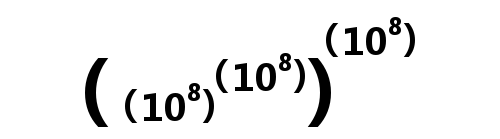
Ancient Greeks did not have the numbers and place value system we use today. They expressed numbers with letters of the alphabet. The largest basic unit was “myriad,” which was equal to 10,000.
With this system, it became difficult to express numbers larger than a few hundred million. Archimedes' calculations, however, required working with much larger numbers.
Therefore, the scientist developed a new counting system. In the first stage, he defined numbers up to 100 million as the first order. Then, he constructed each new order to be 100 million times larger than the previous one.
Thus, the limit of the second order was 10¹⁶, and the limit of the third order was 10²⁴. Archimedes further expanded this system to be able to express a number followed by 800 million zeros.
Interestingly, the scientist did not even need to fully utilize the capabilities of the system he created when calculating the number of grains of sand in the universe.
What do modern calculations show?
Today, the diameter of the observable universe is estimated to be approximately 92 billion light-years. To fill such a vast space with grains of sand of the size Archimedes assumed, approximately 10⁹⁵ grains of sand would be needed.
Nevertheless, even this number remained within the capabilities of the counting system Archimedes created.
Thus, Archimedes' calculation 2300 years ago is considered not only an attempt to understand the vastness of the universe but also one of the important steps in the history of mathematics in terms of expressing large numbers.


